Which Programming Languages Will Be Most In-Demand in 2026–2027?
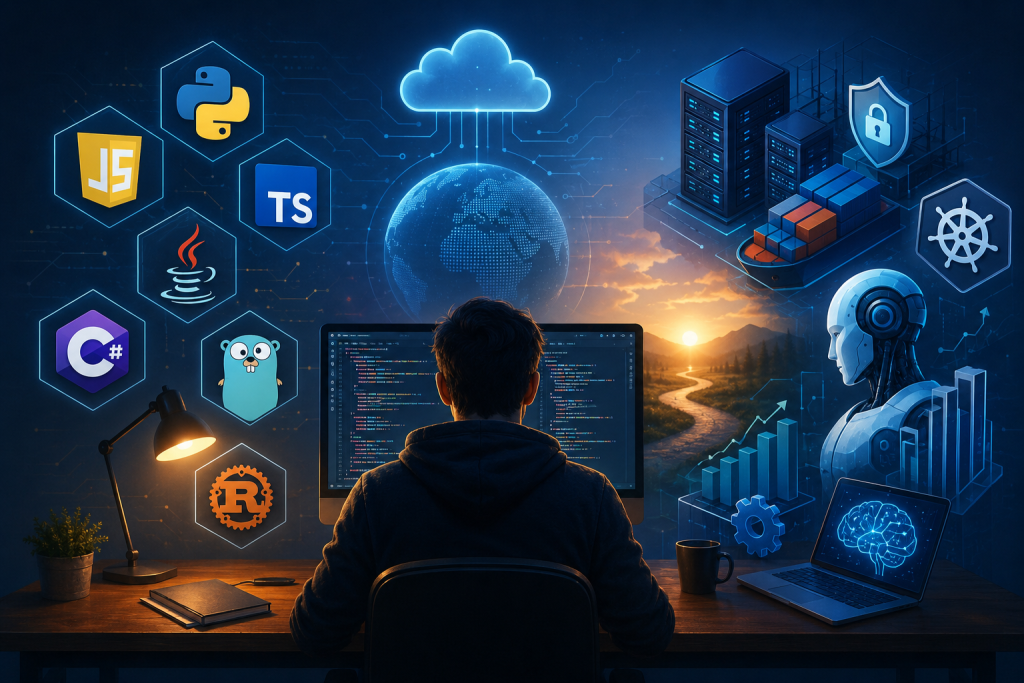
Programming Languages in Demand 2026–2027 are being shaped by AI, cloud computing, automation, cybersecurity, and modern software engineering. Developers who want to stay competitive should focus not only on programming languages but also on databases, cloud platforms, system design, and AI-assisted development.
So, an important question for both new and experienced developers is:
TypeScript for Modern Web Development
The answer is not simply one language.
The developers who will remain competitive in 2026, 2027 and beyond will combine strong programming fundamentals with AI, cloud, databases, system design, and real-world problem-solving skills.
1. TypeScript – A Major Language for Modern Web Development
TypeScript has become one of the most important technologies for modern software development.
GitHub’s 2025 Octoverse data reported that TypeScript became the most-used programming language on GitHub by monthly contributors in August 2025, overtaking both Python and JavaScript.
For developers interested in:
- React.js
- Next.js
- Node.js
- Full-Stack Development
- SaaS Applications
- Enterprise Web Applications
- API Development
learning TypeScript is becoming increasingly valuable.
JavaScript is still fundamental to the web, but developers who already know JavaScript should seriously consider strengthening their TypeScript skills.
2. Python – AI, Data and Automation Will Keep Driving Demand
Python remains one of the strongest languages for future-focused developers.
Its ecosystem is heavily used in:
- Artificial Intelligence
- Machine Learning
- Data Science
- Data Engineering
- Automation
- Backend Development
- API Development
- Scientific Computing
The 2025 Stack Overflow Developer Survey reported that Python adoption increased significantly compared with the previous year, highlighting its continued strength across AI, data science and backend development.
As businesses continue integrating AI into their products and operations, developers who understand both Python and AI engineering should have increasingly valuable skills.
3. Java – Enterprise Development Is Not Going Away
Java continues to be extremely important for large enterprise applications.
It remains relevant across industries such as:
- Banking
- FinTech
- Enterprise ERP
- Large Backend Systems
- Insurance
- Telecommunications
- Government Systems
- Microservices
Developers targeting enterprise software careers should consider building strong knowledge of Java together with technologies such as Spring Boot, REST APIs, SQL, microservices and cloud platforms.
Java may not always generate the same hype as newer languages, but enterprise systems require reliability, maintainability and long-term support—areas where Java continues to have a strong position.
4. C# and .NET – Strong for Enterprise and Cloud Applications
C# remains another valuable language, particularly within the Microsoft ecosystem.
Developers using C# can work across:
- Enterprise Software
- ASP.NET Core
- REST APIs
- Cloud Applications
- Microsoft Azure
- Desktop Applications
- Business Management Systems
- Game Development
GitHub’s 2025 data also showed continued C# growth, reflecting the ongoing strength of the .NET ecosystem.
For developers targeting corporate and enterprise environments, C# + .NET + Azure + SQL can still be a powerful career combination.
5. Go – A Language to Watch for Cloud and Backend Engineering
Go, or Golang, has become increasingly important in cloud-native and infrastructure-oriented development.
It is especially useful for:
- High-performance APIs
- Microservices
- Distributed Systems
- Cloud Infrastructure
- DevOps Tools
- Networking Applications
- Backend Services
Many developers who start with Python, JavaScript or other high-level languages eventually become interested in Go when they move toward scalable backend and infrastructure engineering.
The Stack Overflow 2025 survey also showed interest among Python developers in moving toward languages such as Go and Rust for performance-oriented development.
6. Rust – Growing Importance in Performance and Systems Engineering
Rust is another language developers should keep watching.
It is particularly attractive for areas requiring:
- Performance
- Memory Safety
- Systems Programming
- Security
- Infrastructure
- Developer Tools
- Performance-sensitive Services
Rust was again among the most admired programming languages in Stack Overflow’s 2025 Developer Survey.
Rust may not be the first programming language every beginner needs to learn, but it can be an excellent specialization for developers interested in deeper systems engineering.
Learning a Programming Language Is No Longer Enough
One of the biggest mistakes developers can make today is focusing entirely on frameworks and programming syntax.
Knowing React, Python, Java or Node.js alone does not automatically make someone a strong software engineer.
Modern developers should gradually build knowledge across several areas.
Strong Programming Fundamentals
Understand:
- Data Structures
- Algorithms
- Object-Oriented Programming
- Functional Programming Concepts
- Design Patterns
- Clean Code
- Debugging
- Testing
Frameworks change quickly.
Programming fundamentals remain useful throughout a developer’s career.
Database Skills
Every serious developer should understand databases.
Important areas include:
- SQL
- PostgreSQL
- MySQL
- Oracle
- Database Design
- Indexing
- Query Optimization
- Transactions
- Data Modeling
Developers who can build an application but cannot understand its data layer will have limitations when working on larger systems.
Backend and API Engineering
Developers should know how modern systems communicate.
Important topics include:
- REST APIs
- Authentication
- Authorization
- API Security
- Caching
- Background Jobs
- Message Queues
- WebSockets
- Microservices
Cloud Computing
Cloud knowledge is becoming increasingly important.
Developers should understand the fundamentals of platforms such as:
AWS, Microsoft Azure or Google Cloud Platform.
You do not need to master every cloud platform.
Understanding one properly is better than knowing a little about all of them.
Docker, DevOps and CI/CD
Knowing how software is deployed is becoming part of modern development.
Developers should understand:
- Docker
- Linux
- Git
- GitHub
- CI/CD
- Basic Networking
- Deployment
- Monitoring
Developers interested in advanced cloud engineering can later explore Kubernetes and infrastructure automation.
AI Will Change Development — But Developers Still Matter
AI is already becoming part of normal software development workflows.
According to Stack Overflow’s 2025 Developer Survey, 84% of respondents were using or planning to use AI tools in their development process.
GitHub also reported major growth in AI-related software projects during 2025.
This means developers should not ignore AI.
But developers should also avoid becoming completely dependent on it.
A developer should be able to:
- Understand AI-generated code
- Verify whether the solution is correct
- Detect security problems
- Review architecture
- Debug unexpected behavior
- Write tests
- Optimize performance
- Understand business requirements
AI can generate code quickly.
Engineering judgment determines whether that code belongs in production.
What Should a Developer Learn in 2026?
Instead of trying to learn ten programming languages, choose a career direction.
For Web & Full-Stack Development:
JavaScript → TypeScript → React/Next.js → Node.js → SQL → Cloud
For AI & Machine Learning:
Python → SQL → Data → Machine Learning → LLMs → AI Engineering
For Enterprise Backend Development:
Java/Spring Boot or C#/.NET → SQL → APIs → Microservices → Cloud
For Cloud & Infrastructure Engineering:
Go → Linux → Docker → Kubernetes → Networking → Cloud
For Systems & Performance Engineering:
C/C++ or Rust → Operating Systems → Networking → Distributed Systems
There is no single perfect roadmap for everyone.
Your roadmap should depend on the type of engineer you want to become.
The Future Developer Will Be More Than a Coder
The definition of a software developer is changing.
Companies increasingly need people who can connect:
Business Problems + Software Engineering + Data + Cloud + AI
The most valuable developers will not necessarily be those who can write the largest amount of code.
They will be developers who can understand a problem, design the right solution, use AI productively, build reliable systems and continuously learn new technologies.
Final Thoughts
Programming languages will continue to evolve.
Frameworks will rise and fall.
New AI tools will appear.
But several things will remain valuable:
Strong fundamentals.
Problem-solving ability.
System thinking.
Database knowledge.
Cloud knowledge.
Communication skills.
And the ability to continuously learn.
So instead of only asking:
“Which programming language should I learn next?”
Ask yourself:
“What kind of engineer do I want to become?”
Choose that direction and build your skills around it.
The future belongs not simply to programmers—but to developers who can combine software engineering, AI and real-world problem solving.